


.png)
Crabbers And ODFW Staff Discuss Next Steps In Crabbing Rules


State fishery managers and commercial crabbers spent three hours in Newport debating how to reduce whale entanglements without sinking Oregon’s Dungeness crab fleet, during a public meeting on the state’s crab/whale management plan and upcoming rule proposals.
The session, led by Oregon Department of Fish and Wildlife (ODFW) Marine Resources Program Manager Justin Ainsworth and license management project leader Brittany Harrison, is one of three public meetings ODFW is holding this month on the coast.
Key decisions will be made at the Oregon Fish and Wildlife Commission’s August 2026 meeting in Salem, where ODFW plans to bring a package on late‑season crab rules, vessel monitoring, and “pop‑up” experimental fishing gear. Staff repeatedly said they are seeking industry and public input now to shape those proposals.
Petition to tighten crab rules denied; state told to “stay the course”
Ainsworth opened with background on a December 2024 petition filed by environmental groups, including the Center for Biological Diversity, Oceana, NRDC, and the American Cetacean Society. The petition sought a series of additional crab fishery restrictions tied to whale protections, including late‑season line limits, emergency procedures, and rules for pop‑up gear. ODFW staff brought a response to the Fish and Wildlife Commission in February. After receiving heavy written and oral testimony, the Commission denied the petition and directed staff to continue with Oregon’s existing whale risk‑reduction plan and planned rulemakings, rather than adopting the petition package.
Conservation plan targets humpbacks, blue and fin whales
Harrison briefed the room on the state’s draft conservation plan, which is being prepared to support a 15‑year federal incidental take permit under the Endangered Species Act (ESA). The plan focuses on, two distinct population segments of humpback whales: Central America (listed as endangered) and Mexico (listed as threatened)– Blue whales– Fin whales
Leatherback sea turtles, which were included in earlier drafts, have been removed from the current plan. Harrison said National Marine Fisheries Service (NMFS) staff advised that, given no documented takes in the Oregon crab fishery and the species’ current status, they likely could not make the required finding that take is “reasonably certain to occur,” a prerequisite for ESA coverage.
Under the plan, Oregon must also secure authorization under the Marine Mammal Protection Act, which would likely require a federal Take Reduction Team process for the crab fishery similar to what sablefish has already undergone. That creates additional uncertainty on timing, but ODFW said its goal is to submit a final conservation plan and incidental take permit application in late 2026.
Five‑year review: late‑season rules cut line “risk,” but entanglements up
A major focus of the meeting was ODFW’s upcoming five‑year evaluation of risk‑reduction rules adopted in 2020, including: – Late‑season measures starting May 1: 20% pot reduction, 40‑fathom depth restriction, late‑season tags– Elimination of the standard 10% replacement tag allowance– Elimination of the two‑week postseason gear “cleanup” period. Those measures were designed to cut the total number of vertical lines in the water, especially after spring, when humpback whales are more common off Oregon.
ODFW and NMFS attribute the increase in whale entanglements to multiple factors: more public awareness and reporting, improved gear marking that makes it easier to identify Oregon gear, a growing West Coast humpback population overall, and changing ocean conditions that may alter whale and crab distribution. Staff also noted that the Central America humpback population, the most sensitive ESA stock, is thought to be roughly stable rather than increasing. Importantly for the fleet, ODFW said none of the confirmed entanglements to date have carried Oregon’s late‑season tags, suggesting those events originated outside the May–August “late season” window.
April 1 rule change draws sharp criticism on safety, process.
Several fishermen sharply criticized ODFW’s decision this year to use temporary rulemaking to move the late‑season measures forward from May 1 to April 1, following elevated entanglement numbers in 2024 and 2025 and public attention on one high‑profile stranded whale. Industry speakers said the March–early April period is often marked by strong currents and poor weather, especially on the south coast, and that forcing a 20% pot reduction and shallow‑water move then created serious safety concerns and compliance problems for smaller boats.
Several themes emerged in public comment:
– Fishermen said March landings data already show low fishing activity due to weather and poor crab “catchability,” and that the April 1 date does not reflect on‑the‑water realities.– Some called for an April 15 compromise, or a flexible “X days after season opening” trigger instead of a hard calendar date, to account for delayed openers and market conditions.– Multiple speakers said they felt blindsided by the April 1 rule, describing it as a rushed response to environmental group pressure and media attention rather than a measured adaptive‑management step.
ODFW staff countered that they had signaled possible April changes in advisory committee meetings and industry notices in 2024–25, and that the decision was based on elevated multi‑year entanglement levels and new co‑occurrence modeling showing peak whale–fishery overlap in April off Oregon. They acknowledged, however, that the short timeline and March conditions created real challenges, and said those comments will factor into the August rule proposals.
Economic and participation impacts
Preliminary ODFW analysis suggests the late‑season rules have had relatively little impact on overall fishery participation and total landings. The average number of active permits in May–August and total pounds landed by month were similar or higher in most months after implementation, with small declines in July and August.
Agency staff emphasized that this is an aggregate picture and may mask impacts on particular segments of the fleet, including small boats, certain pot tiers, and specific ports. They said the full August report will break down results by pot limit, vessel length, and port to identify any disproportionate effects.
Adaptive‑management triggers tied to entanglement and line‑day metrics
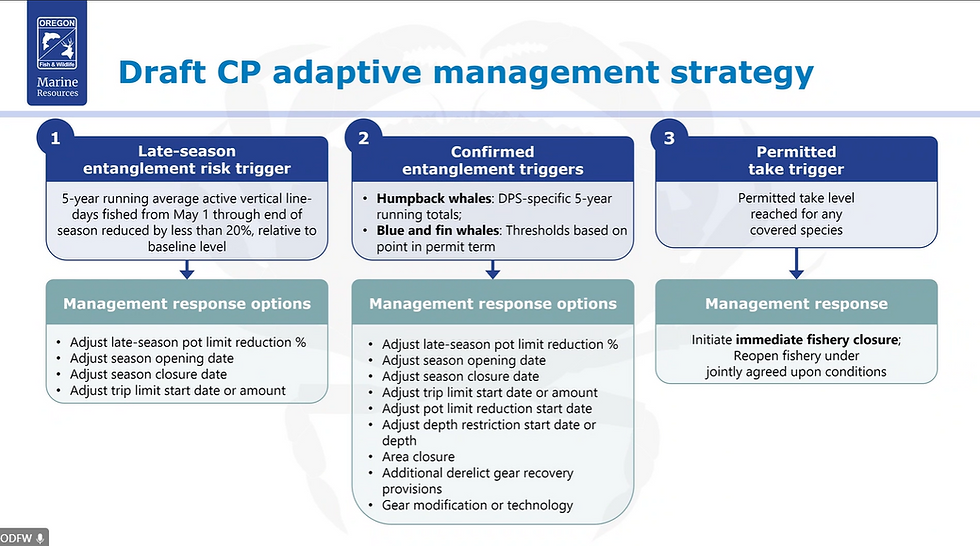
Under the draft conservation plan, Oregon will adopt an adaptive‑management framework with three main “pathways”: – If late‑season line days are not reduced at least 20% (based on a five‑year running average), ODFW would consult with NMFS and consider additional risk‑reduction steps, likely through temporary rules affecting the following season.– If entanglement counts for covered species reach specified thresholds (still under negotiation with NMFS), ODFW would again consult with NMFS and could implement added restrictions anywhere in the season.– If total permitted take for any covered species is reached, the crab fishery would be closed until ODFW and NMFS agree on reopening conditions.
A major portion of the meeting was devoted to a proposal to require electronic vessel monitoring on all commercial crab vessels by December 1, 2026, and to phase in electronic logbooks by 2030. ODFW argues that the system would: – Provide near‑real‑time information on where and how intensely crab gear is fished, improving whale–fishery co‑occurrence analysis and allowing more targeted management instead of broad closures– Streamline data collection compared to paper logbooks, which are often incomplete, delayed, and take years to fully enter and check– Support enforcement of existing rules, such as fair‑start provisions and area closures, and help investigate pot theft and gear conflicts.
Crabbers raised significant concerns about:
– Cost: unit and sensor purchase, ongoing subscription fees (examples cited in the meeting were roughly $255–$365 for 6–10 months of service, plus hardware and any technician work) and future repair or replacement costs– Timeline: implementing both hardware and enforcement by December 2026 was widely described as too fast, particularly given equipment supply issues seen recently with required line colors and tags– Redundancy: some larger boats already carry AIS and federal VMS, and vessel owners questioned why yet another device is needed– Enforcement risk: questions were raised about what happens if a unit fails on opening day or offshore during a weekend, and whether vessels would be ordered in or granted waivers
ODFW said it has funding to reimburse much of the initial hardware cost and aims to roll out units and reimbursement starting this summer, before rules are final. Staff said Oregon would likely follow Washington’s more flexible approach on equipment failures, using waivers rather than automatic orders to port.
On the electronic logbook side, ODFW has been piloting an app‑based system with a small group of vessels since 2022. The tool records set and haul position, depth, number of pots, soak times, and catch, and now includes a derelict gear reporting feature. The agency proposes voluntary use starting next season, then mandatory e‑logs by the 2030–31 crab season. Some fishermen who have tested the app spoke favorably about it, but others urged the state to delay any mandate until at least 50% of the fleet has adopted e‑logs voluntarily. Focus on making the system clearly beneficial and easy to use, rather than designing it primarily for future enforcement.
Experimental “pop‑up” and long‑line gear: limited testing planned
The final agenda item was an experimental fishing gear permit program to test “pop‑up” or “ropeless” gear and conventional long‑line crab strings as tools to reduce the number of vertical lines in the water. Under the concept outlined by ODFW:
– Acoustic or timed “pop‑up” units sit on the seafloor holding buoy and line until triggered, usually as part of a groundline connecting multiple pots.– Deck units send an acoustic signal to release the buoy, which comes to the surface so the crew can haul the long line.– Each string is mapped through a shared “virtual gear marking” app that shows nearby mariners the approximate location of gear from all manufacturers, while enforcement sees full details in a secure portal.
Ainsworth and staff said this type of gear is being tested or used in California and on the East Coast, and could eventually give Oregon a way to reduce entanglement risk in specific zones or seasons without full closures, if adaptive‑management triggers are hit.
However, fishermen at the Newport meeting raised extensive concerns:
– Long‑line crab gear was previously phased out in Oregon because of safety hazards and severe gear conflict; some warned the same issues would re‑emerge unless all vessels in an area used the same system.– Every pot on a longline must be stacked on deck, which many see as a safety problem for smaller boats.
Maine’s experience with similar gear was cited as a warning.– Strong currents off Cascade Head, Cape Blanco, and other headlands raise questions about whether single pop‑up buoys can reliably surface in deep water.– Pop‑up units cost in the range of $1,200–$1,400 each, plus a multi‑thousand‑dollar deck box per boat, creating a financial barrier without subsidies or a “gear library.”
ODFW says it intends to start small, likely limiting experimental permits to a modest number of vessels across a few ports (roughly 14–17 permits was discussed as a manageable starting range)– Restricting use initially to closed areas outside 40 fathoms during the late season, then potentially expanding zones as staff and industry gain experience.
Considering a loan‑style “gear library” if funding can be found, to reduce up‑front costs
No firm timeline was set for how long the experimental program would run before any broader policy decisions. Staff said any future requirement for pop‑up or long‑line gear would go through a full public rulemaking, not be imposed directly from experimental permits.
Public comment and next steps.
ODFW staff said they will compile feedback from this and the other coastwide meetings, along with advisory committee input, into recommendations for the August 2026 Fish and Wildlife Commission meeting in Salem.
That agenda is expected to cover:
– The five‑year evaluation of existing whale risk‑reduction measures, including any proposed changes to late‑season dates or requirements– A proposed rule to require vessel monitoring on crab boats– A framework for experimental pop‑up and long‑line gear permits
Fishermen and members of the public will be able to submit written comments and testify at that meeting. ODFW also indicated it will issue advance industry notices and post draft rules before they are filed, giving crab permit holders a chance to review and respond.


Comments